Good balance is something most of us take for granted until it starts to slip. As we age, changes in muscle strength, vision and reaction time can make falls more likely. The good news is that balance can be trained, just like strength.
This gentle routine combines simple balance moves with leg and core strengthening, all done next to a sturdy chair or counter for support. Balance exercises are one of the four types of exercise recommended for older adults, along with endurance, strength and flexibility.
Balance and Strength Routine for Older Adults: At a Glance
Before You Start
- Always keep a sturdy chair, counter or wall within reach.
- Wear supportive shoes with non-slip soles.
- Clear the area of rugs, cords and clutter.
- Have someone nearby the first few times if you’re worried about falling.
- If you’ve had a recent fall, dizziness or a joint replacement, check with your doctor or a physical therapist first.
Warm-Up (3 to 5 minutes)
- March in place for 1 to 2 minutes while holding the chair.
- 10 shoulder rolls backward.
- 10 ankle circles in each direction, one foot at a time.
- 5 slow sit-to-stands from a chair.
The Workout
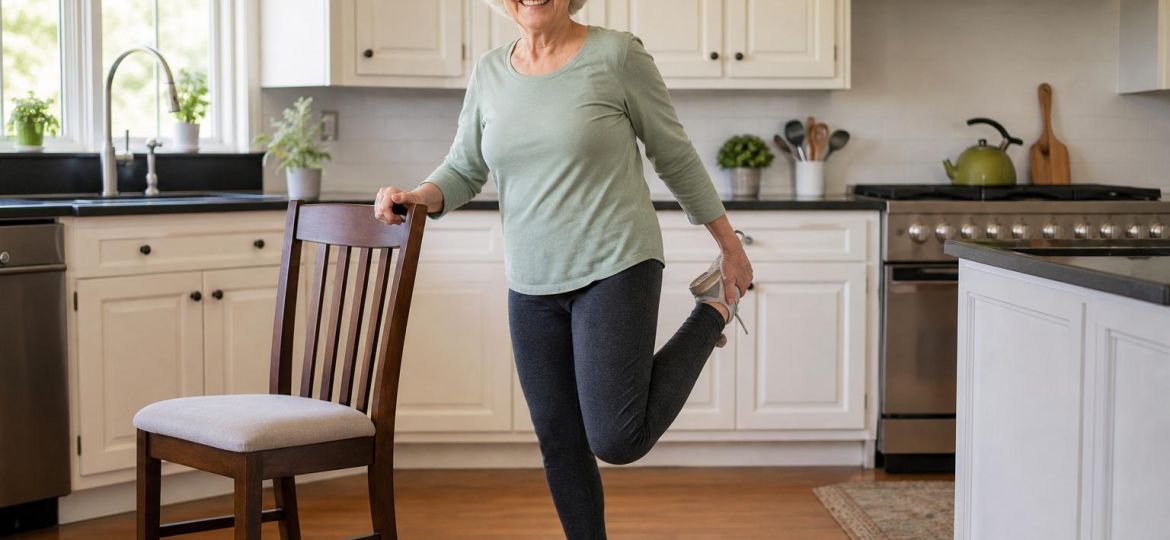
Stand behind a sturdy chair and hold the back with one or both hands. Do each exercise for the listed reps or time. Rest as needed. As you get steadier, hold on with one hand, then just your fingertips.
- Sit-to-stand (8 to 10 reps)
Sit near the front of a sturdy chair. Lean forward slightly and stand up without using your hands if you can. Slowly sit back down. Form tip: Lower yourself with control rather than dropping into the chair. - Single-leg stand (Hold 10 to 30 seconds per leg)
Holding the chair, lift one foot slightly off the floor and balance on the other leg. Form tip: Stand tall and look straight ahead, not down. - Heel-to-toe walk (10 to 20 steps)
Next to a counter or wall, walk in a straight line placing the heel of one foot directly in front of the toes of the other. Form tip: Fix your eyes on a point ahead of you. - Side leg raise (8 to 10 reps per leg)
Holding the chair, slowly lift one leg out to the side, keeping your toes pointing forward. Lower slowly. Form tip: Keep your upper body upright and don’t lean. - Heel and toe raises (10 reps each)
Holding the chair, rise up onto your toes, then lower. Next, rock back onto your heels and lift your toes. Form tip: Move slowly to build control. - Standing march (30 seconds)
Holding the chair, march in place, lifting your knees as high as is comfortable. Form tip: Try to pause briefly with each knee up.
Cool-Down (3 to 5 minutes)
- Seated calf stretch: straighten one leg and gently flex your foot, 20 to 30 seconds per leg.
- Seated hamstring stretch: 20 to 30 seconds per leg.
- Neck stretches: gently tilt your ear toward each shoulder.
- Deep breathing: 5 slow breaths in and out.
Make It Easier or Harder
- Easier: Hold the chair with both hands and shorten balance holds.
- Harder: Hold with one fingertip, then try letting go briefly. Later, try closing your eyes during single-leg stands, only with support right next to you.
- Add strength: Wear light ankle weights for leg raises once the moves feel easy.
- Try tai chi: Classes focused on slow, flowing movements are another proven way to improve balance.
Why This Workout Helps
Falls are a leading cause of injury in older adults, and weak leg muscles and poor balance are two of the most important risk factors. Practicing balance and strengthening the legs and core makes it easier to recover when you trip and helps you move with more confidence.
These exercises also make everyday activities like getting out of a chair, climbing stairs and carrying groceries easier, helping you stay independent longer.
This article is for general information and isn’t medical advice. Check with your doctor before starting a new exercise program, especially if you have heart disease, diabetes, high blood pressure, joint problems, a lung condition or another health concern. Stop and seek medical help if you feel chest pain, dizziness, faintness or severe shortness of breath.