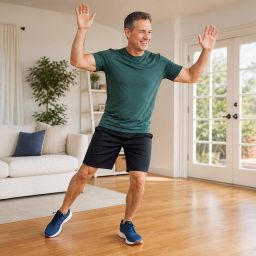
Having asthma doesn’t mean you have to avoid exercise. In fact, staying active can strengthen your heart and lungs and improve overall fitness. Many elite athletes have asthma. The key is to prepare well, pace yourself and follow your asthma action plan.
Some people experience exercise-induced bronchoconstriction, a narrowing of the airways triggered by physical activity, especially in cold, dry air. Mayo Clinic notes that a proper warm-up and pre-exercise medicine prescribed by your doctor can help prevent symptoms. This routine is built around those strategies.
Asthma-Friendly Workout: Warm-Up, Pace and Breathing: At a Glance
Before You Start
- Talk to your doctor before starting, and make sure you have an up-to-date asthma action plan.
- Keep your rescue inhaler with you at all times during exercise.
- If your doctor has prescribed it, use your inhaler 15 to 30 minutes before exercising.
- Avoid exercising outdoors on high-pollen or poor air quality days, or in very cold air. On cold days, exercise indoors or cover your nose and mouth with a scarf.
- Don’t exercise if your asthma is already flaring or you have a respiratory infection.
Warm-Up (10 to 15 minutes)
- Walk at an easy pace for 5 minutes.
- Gradually increase to a moderate pace for 5 minutes.
- Add 3 to 4 short, gentle bursts (about 30 seconds each) at a slightly faster pace, with easy walking in between. A longer, gradual warm-up can reduce symptoms during the main workout.
The Workout
The main workout uses steady, moderate activity with built-in recovery breaks. Breathe in through your nose when possible, which warms and humidifies the air. Do 2 to 3 rounds.
- Steady brisk walk or stationary bike (5 minutes)
Move at a pace where you can still talk in full sentences. Form tip: Keep your breathing smooth and steady. - Bodyweight squats (10 to 12 reps)
Feet hip-width apart, push your hips back and bend your knees, then stand. Form tip: Exhale as you stand up. - Wall push-ups (10 to 12 reps)
With hands on a wall, lower your chest toward the wall and push back. Form tip: Exhale as you push. - Step-ups (8 to 10 per leg)
Step up onto a low, sturdy step, then step down. Form tip: Hold a railing for balance. - Recovery breathing (1 to 2 minutes)
Walk slowly and practice pursed-lip breathing: inhale through your nose for 2 counts, then exhale slowly through pursed lips for 4 counts. Form tip: Use this whenever you feel short of breath.
Cool-Down (5 to 10 minutes)
- Walk slowly for 5 minutes, letting your breathing return to normal. A gradual cool-down helps your airways adjust.
- Calf, quad and hamstring stretches: 20 to 30 seconds each.
- Chest opener stretch: 20 to 30 seconds.
Make It Easier or Harder
- Easier: Shorten the main workout, extend recovery breaks or choose swimming, which many people with asthma find easier because of the warm, humid air.
- Harder: Add a third round or extend the steady cardio blocks, building up gradually over weeks.
- Good options: Walking, swimming, cycling, yoga and team sports with short bursts of activity are often well tolerated.
- Track symptoms: Note when symptoms happen to help your doctor adjust your plan.
Why This Workout Helps
Regular exercise can improve lung function, build endurance and support overall health in people with asthma. A long, gradual warm-up can help reduce exercise-induced symptoms, and steady pacing avoids sudden spikes in breathing demand.
Stop exercising and use your rescue inhaler as directed if you have coughing, wheezing, chest tightness or shortness of breath. Seek emergency care if symptoms don’t improve with your inhaler.
This article is for general information and isn’t medical advice. Check with your doctor before starting a new exercise program, especially if you have heart disease, diabetes, high blood pressure, joint problems, a lung condition or another health concern. Stop and seek medical help if you feel chest pain, dizziness, faintness or severe shortness of breath.