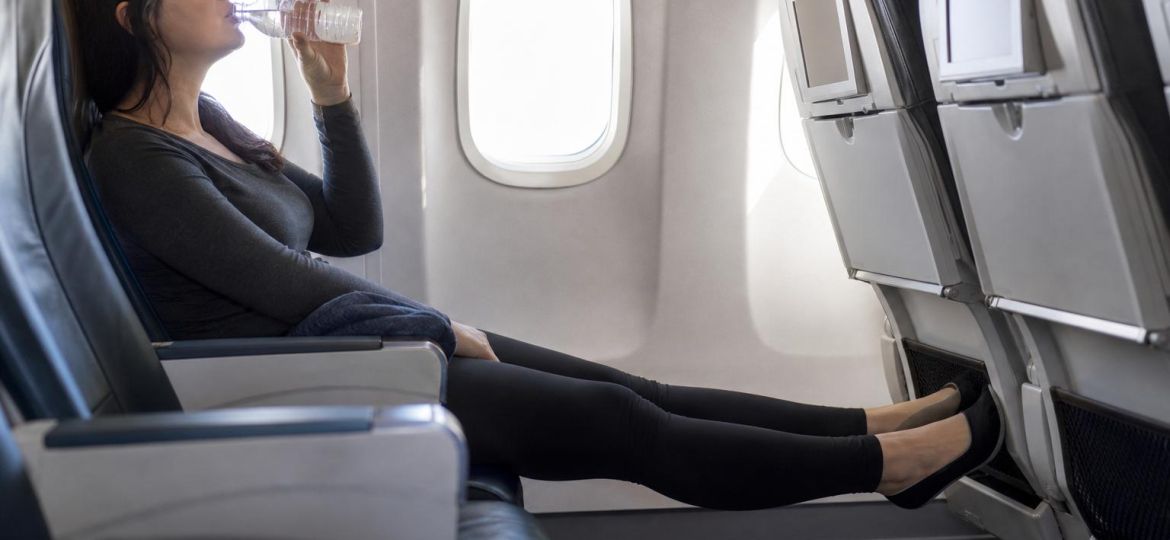
Air travel has bounced back, and flights are getting longer. Some airlines are planning nonstop routes of 19 hours or more. Spending that long in a pressurized metal tube at 35,000 feet is safe for most people, but it does put some unusual demands on the body. Here’s what happens on a long-haul flight and how to arrive feeling better.
Dehydration
If your nose, throat, eyes and skin feel dry on a plane, you’re not imagining it. Cabin air is very dry because much of it is drawn in from outside the aircraft, where the air at high altitude holds very little moisture. Humidity in the cabin is often far lower than what we’re used to on the ground.
The longer the flight, the more fluid you can lose. Drinking alcohol or lots of caffeine, and not drinking enough water because you want to avoid trips to the restroom, can make it worse. Dehydration can leave you tired, headachy and more prone to feeling unwell when you land.
Blood clots
Sitting still for hours slows blood flow in the legs, which raises the risk of a blood clot called deep vein thrombosis (DVT). In rare cases, part of a clot can break off and travel to the lungs, causing a pulmonary embolism, which is a medical emergency.
Research suggests the risk grows with flight length. Analyses cited in a 2022 scientific review found that the risk rises with every additional couple of hours spent in the air, beginning after about four hours of travel. The overall risk for a healthy traveler is still low, but it’s higher for people who:
- Have had a blood clot before, or have a family history of clots
- Recently had surgery or an injury
- Are pregnant or recently gave birth
- Use estrogen-containing birth control or hormone therapy
- Are older or have obesity
- Have cancer or limited mobility
Warning signs of a clot include swelling, pain, warmth or redness in one leg. Sudden shortness of breath or chest pain needs emergency care.
Cosmic radiation
At cruising altitude, there’s less atmosphere to shield you from cosmic radiation that comes from space. According to the CDC’s National Institute for Occupational Safety and Health (NIOSH), aircrew members are among the workers with the highest yearly radiation doses because they spend so much time in the air. For occasional travelers, the dose from a single flight is small and unlikely to cause harm. People who are pregnant or fly very frequently may want to discuss it with a doctor.
Other effects
Long flights can also cause swollen feet and ankles, ear pain from pressure changes, gas and bloating as air in the gut expands at altitude, and jet lag when crossing several time zones. Crowded cabins also make it easier to pick up a cold or other respiratory infection.
What this means for you
- Drink water regularly. Start before you board and sip throughout the flight. Go easy on alcohol.
- Move often. Walk the aisle every hour or two when it’s safe, and do seated calf raises and ankle circles.
- Choose an aisle seat if you’ll need to get up frequently.
- Consider compression stockings. They can lower the risk of DVT on long flights. If you have clot risk factors, ask your doctor what’s right for you.
- Moisturize. Lip balm, saline nasal spray and eye drops can ease dryness.
- Limit germ exposure. Wash or sanitize your hands, and consider a mask in crowded settings. Avoid flying when you’re sick.
- Talk to your doctor first if you’re pregnant, recently had surgery or have heart or lung disease.
The bottom line
Long flights can dry you out, slow blood flow in your legs and expose you to a little extra radiation. For most travelers, simple steps like staying hydrated and moving regularly go a long way toward arriving healthy.
This article is for general information and isn’t medical advice. Talk with your healthcare provider about your individual needs.